Relevance 9/10Importance 10/10
In Tim Cook's final WWDC keynote as CEO, Apple unveiled "Siri AI" — a ground-up rebuilt assistant powered by a new Apple Intelligence architecture developed in collaboration with Google's Gemini models, with Claude available as an on-device option for the first time. The new Siri features a full-screen conversational interface, cross-device iCloud-synced conversation history, and a standalone Siri app. Hardware requirements are steep (iPhone Air or iPhone 17 Pro/Max, iPad M4+, Mac M3+ with 12GB RAM), and the EU and China are locked out due to regulatory constraints.
Relevance 10/10Importance 9/10
In a paper titled "When AI Builds Itself," co-authored by co-founder Jack Clark, Anthropic disclosed that Claude now writes more than 80% of code merged into Anthropic's own production systems — a landmark threshold for AI-assisted engineering at a frontier lab. In the same paper, Anthropic called for an internationally coordinated, verifiable pause on frontier AI development before recursive self-improvement thresholds are crossed. Critically, Anthropic will not slow down unilaterally — only if every major frontier lab does so simultaneously under verifiable conditions.
Relevance 10/10Importance 9/10
At Build 2026, Microsoft unveiled seven proprietary MAI models trained entirely on commercially licensed data, with zero distillation from OpenAI — a deliberate strategic pivot toward long-term self-sufficiency. The flagship MAI-Thinking-1 is a 35B active parameter reasoning model with a 256K-token context window; MAI-Code-1-Flash is already embedded in GitHub Copilot and VS Code; the suite also includes a vision model, a voice model in 15 languages, and a transcription model. All seven are available now on Azure AI Foundry and through third-party hosts including OpenRouter.
Relevance 9/10Importance 9/10
OpenAI confirmed yesterday it has submitted a confidential Form S-1 to the SEC, with Goldman Sachs and Morgan Stanley as lead underwriters and a potential September 2026 public debut on the table. The company proactively disclosed the filing expecting it to leak — just one week after Anthropic submitted its own S-1. Analyst valuations range from $730B to $850B, with some projections exceeding $1T; the filing will publicly expose OpenAI's financials for the first time, including reports the company currently loses approximately $1.22 for every dollar earned.
Relevance 9/10Importance 9/10
Anthropic submitted its own confidential draft S-1 to the SEC approximately one week before OpenAI's filing, with its most recent private funding round valuing the company at roughly $965 billion — putting a potential IPO within striking distance of a $1 trillion market cap. Two of the most prominent safety-focused AI labs in the world filing for public markets in the same week is an extraordinary inflection point; Wall Street is about to get its first look at what it actually costs to build and run frontier AI.
Relevance 10/10Importance 8/10
xAI rolled out Grok 4.3 to SuperGrok and Premium Plus subscribers, featuring full computer use — autonomous code writing, dependency installation, and file output — plus persistent "Skills" that carry user-defined formatting preferences across sessions. The headline number: $0.50 per million input tokens and $2.00 per million output tokens, dramatically undercutting every major frontier competitor, a price analysts suspect is subsidized. The roadmap is even more aggressive: Grok 4.4 at one trillion parameters and Grok 4.5 at 1.5 trillion are both projected to arrive within weeks.
Relevance 10/10Importance 8/10
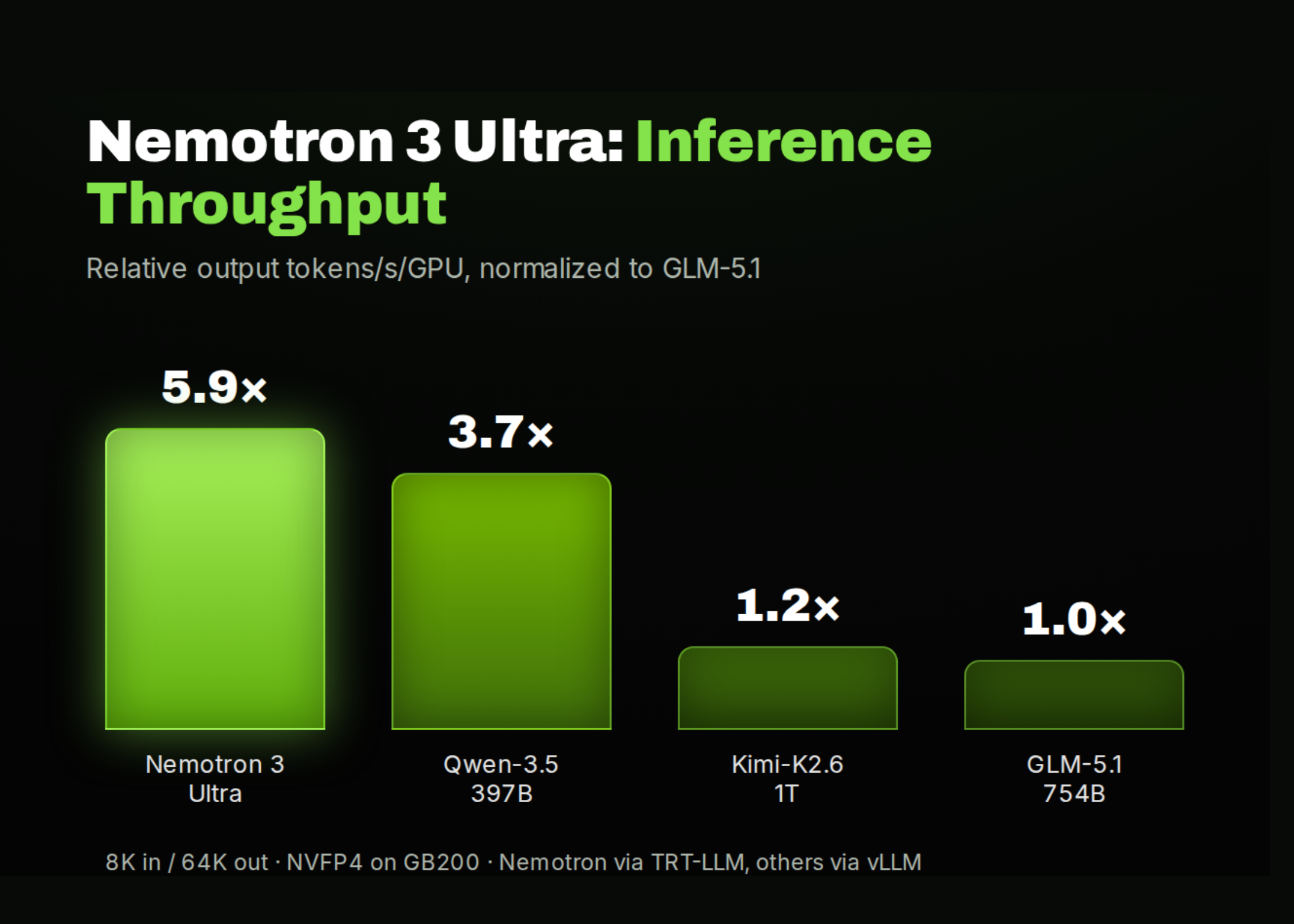
NVIDIA released Nemotron 3 Ultra, a 550B total / 55B active parameter Mixture-of-Experts hybrid Mamba-Transformer model — the largest open-weights US model at launch and the most capable Nemotron to date. Pre-trained on approximately 20 trillion tokens, it claims 5x faster inference and 30% lower cost than comparable open frontier models, with a 200K-plus token context window and 300-plus tokens per second on DeepInfra. Weights are freely available on Hugging Face and through NVIDIA NIM microservices.
Relevance 10/10Importance 8/10
Google's Gemini 3.5 Pro, announced at I/O but held in limited Vertex AI preview, is on track for general availability in June per Sundar Pichai's public commitment. Expected specs include a 2-million-token context window, a Deep Think reasoning mode for extended multimodal analysis, and frontier-class performance; pricing is projected at approximately $15 per million input tokens and $60 per million output tokens. With Gemini growing chatbot market share by 104% in six months, the full GA launch sets the competitive benchmark for H2 2026.
Relevance 8/10Importance 9/10
Defense Secretary Pete Hegseth declared Anthropic a supply-chain risk in March after Claude refused to strip guardrails prohibiting mass surveillance and autonomous weapons use; the Pentagon is now running comparative evaluations of OpenAI, Google, and xAI Grok as replacements. Claude had been deeply embedded in the classified Maven Smart System, and Anthropic is fighting the supply-chain designation in court, arguing the ruling could cost the company billions in revenue. The case has become a live test of whether AI safety commitments are commercially viable in the defense market — particularly as Anthropic simultaneously files for a near-trillion-dollar IPO.
Relevance 10/10Importance 7/10
OpenAI is rolling out Dreaming V3, a new background memory architecture for ChatGPT that automatically synthesizes context from every prior conversation without requiring explicit "remember this" instructions. The system runs at 5x the compute efficiency of its predecessor, achieves 82.8% factual recall and 71.3% preference adherence, and memories self-update over time as facts change. The rollout begins with Plus and Pro users in the US, with Free tier and international availability to follow.