Anthropic raised $65 billion in a Series H that pushed its valuation to $965 billion — surpassing OpenAI's $852B and closing in on the trillion-dollar mark. The company simultaneously released Claude Opus 4.8, which shows substantially lower rates of deceptive behavior than its predecessor, and confirmed its Mythos-class models — capable of autonomously chaining software vulnerabilities into cyberattack sequences — will enter wide release in coming weeks.
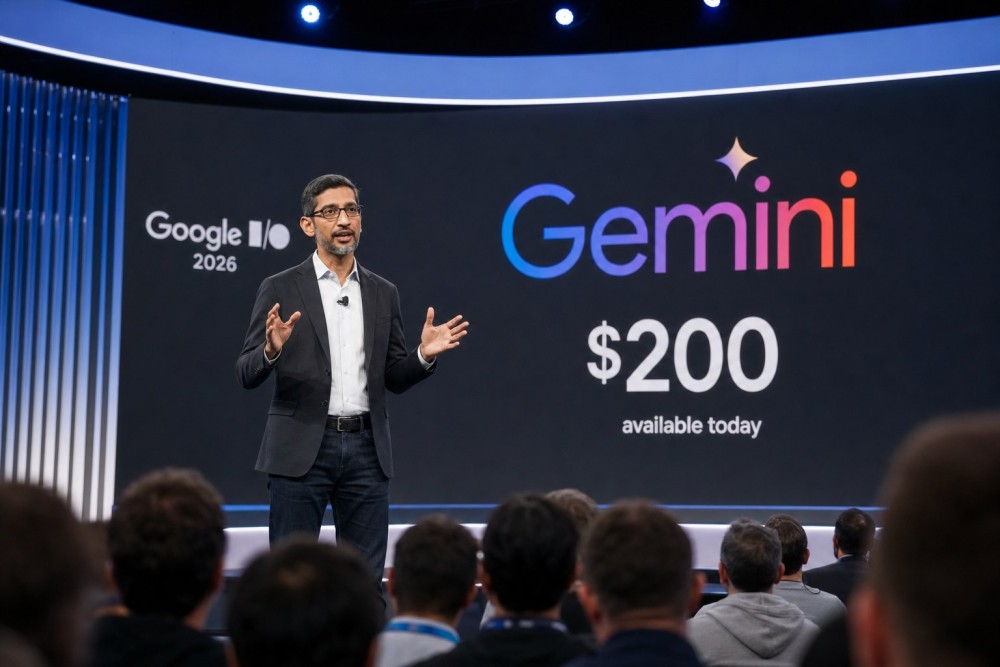
Google launched Gemini 3.5 Flash at I/O 2026, a frontier-speed model that outperforms Gemini 3.1 Pro on coding and agentic benchmarks and is now the default engine behind Google Search's AI Mode globally. Google also unveiled Gemini Spark, a personal agent that acts on users' behalf across their digital lives — available next week to AI Ultra subscribers in the US — while cutting the Ultra subscription from $250 to $200 per month as Gemini monthly users hit 900 million.
OpenAI co-founder and one of the field's most influential researchers, Andrej Karpathy, has joined Anthropic to lead a new team using Claude to accelerate pre-training research, reporting to Anthropic's head of model development Nick Joseph. It's a significant talent coup that signals Anthropic's ambitions at the frontier model level — not just the product level.
DeepSeek has made its temporary 75% price cut on V4-Pro permanent, setting input token pricing at roughly $0.44 per million — more than 20 times cheaper than comparable models from OpenAI, Anthropic, and Google. Cache-hit pricing fell to one-tenth of previous costs, putting enormous pressure on Western AI labs whose moats now depend heavily on ecosystem lock-in rather than raw price competitiveness.
Google DeepMind has brought in more than 20 researchers from Contextual AI — including co-founder and CEO Douwe Kiela — under a licensing deal valued at $80 to $90 million. The acquisition-via-license structure lets DeepMind absorb world-class research talent without triggering formal acquisition scrutiny, a playbook the industry is increasingly running.
Starting today, GitHub Copilot transitions from flat-rate subscription to usage-based billing via GitHub AI Credits, where 1 credit equals $0.01. Code completions remain free, but agentic workflows and AI code review now draw from a monthly credit pool, with overages at published API rates. Developer forums are already warning that for heavy users, the change means paying the same price for meaningfully less capacity.
Tech layoffs in 2026 have exceeded 142,000 — with nearly 50,000 positions explicitly attributed to AI — as profitable companies including Meta, Amazon, and Oracle slash workforces to fund a combined $700 billion capital expenditure buildout. Stanford HAI data shows software developer employment for workers under 26 fell nearly 20% since 2024.
Hundreds of Wikipedia volunteer editors are organizing a potential strike after the Wikimedia Foundation disbanded its six-person Community Tech team — the unit responsible for the MediaWiki platform — in a move widely read as AI-driven cost-cutting. Actions under discussion include editing strikes and replacing Wikimedia's fundraising banners with protest messages.
Amazon has shut down its internal KiroRank AI productivity leaderboard after employees inflated usage metrics to game the rankings — rendering the system meaningless. The company has pivoted to a new metric called "normalized deployments," focused on whether AI is generating real shipped outcomes rather than raw activity counts.
Chinese courts have started enforcing a legal framework that bars companies from using AI as the sole justification for worker dismissals — marking the first meaningful judicial enforcement of AI-labor protections anywhere in the world. The rulings land as labor-AI tensions surface globally, from Wikipedia volunteers to UK thinktanks calling for mandatory employee consultation before AI-driven workforce changes.