← Kilroy’s Daily Briefings
🎬 AI Video Intel

🎬 AI Video Intel — Tuesday, June 2, 2026 at 6:45 AM

🎬 AI Video Intel6/2/2026🕐 6:45 AMVideo modelsVisual AI

Top stories, ranked by relevance.

Story cards stay below the sticky dock while audio, chapters, date, and brief navigation remain accessible.

#1YouTube Now Auto-Detects AI Content — Label It or YouTube Labels It For You

As of May 27, YouTube's systems began automatically identifying and applying AI-generated labels to realistic video — creators who skip self-disclosure will have labels applied by the platform itself. On long-form, the label moves above the channel icon; on Shorts, it lands bottom-left. YouTube confirmed no monetization or algorithmic distribution penalty for properly labeled content, but mass-produced and template-cloned channels remain squarely in the "repetitious content" demonetization crosshairs.


#2Instagram Testing Account-Level "AI Creator" Badge — With a Real Reach Penalty

Starting May 4, Instagram began rolling out an account-level AI Creator badge for accounts that regularly publish AI-generated content, visible on the profile and alongside every post and Reel. Unlike TikTok and YouTube, Meta's systems appear to suppress labeled AI content algorithmically — early data shows 23–47% lower organic reach compared to human-generated content. Monetization eligibility is technically unaffected, but a near-halved organic reach is the real cost of doing business here.

#3Hailuo 2.3 Drops With a 50% Cheaper Fast Variant for Batch Work

MiniMax released Hailuo 2.3 this week — incremental over Hailuo 02, with improvements to live-action facial performance, micro-expression rendering, and object motion response. The headline for working creators is Hailuo 2.3 Fast: a batch-generation variant at 50% lower cost than standard, with no price increase to the regular tier. The update is live across the website, mobile app, and Open Platform API.

#4Veo 3.1 Adds Native Multilingual Dubbing in One Single Pass

A weekend update to Google's Veo 3.1 added native multilingual dubbing — voiceover tracks across multiple languages generated simultaneously with no separate pipeline. The model also now outputs native 9:16 vertical video for Shorts and mobile, with upscaling to 4K available. Both features are live via the Gemini API and Google Vids, paired with Lyria 3 for AI music.

#5Wan 2.7 Available Now on Apache 2.0 — 60B Model Teased for Mid-2026

Alibaba's Wan 2.7 adds native single-pass audio generation (BGM, ambience, and character vocals together), start-and-end frame control, natural-language instruction-based video editing, and 1080p-grade skin and fabric quality. The 14B GGUF Q4_K quantization is flagged by the Hugging Face community as viable on 8–10GB VRAM. Alibaba has also confirmed a 60B parameter model targeting 4K output and 30-second clips is coming mid-2026.

#6LTX-2.3 Open Weights: 22B Params, 4K at 50fps, Portrait-Native Training

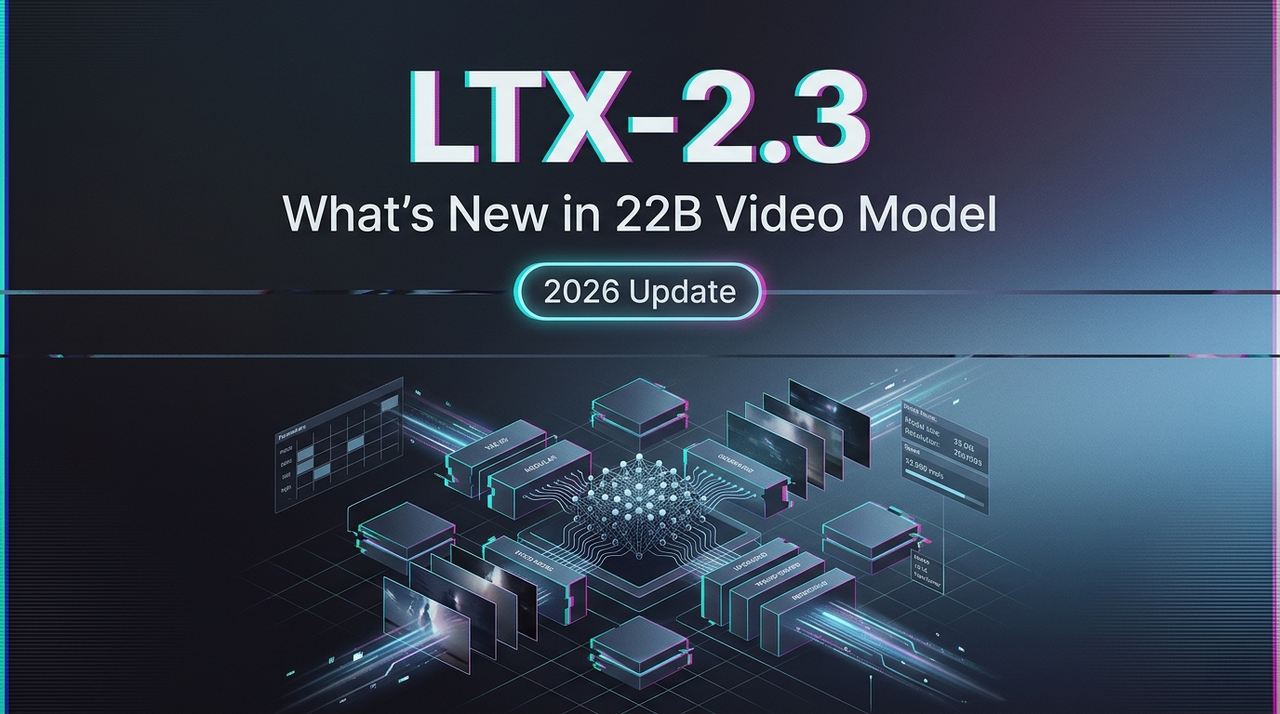
Lightricks' LTX-2.3 is the most capable open-weights video model in the field right now — 22B parameter Diffusion Transformer with single-pass stereo audio, native 1080×1920 portrait output trained on portrait data (not cropped widescreen), and clips up to 20 seconds. A distilled variant runs in as few as 8 denoising steps for fast iteration. Permissive license, GitHub-hosted, and runnable in ComfyUI on an RTX 4090 or 5090.

#7The 5-Layer Prompt Framework Replacing Single-Line Vibes Prompts

The community has moved decisively away from one-line aesthetic prompts in favor of a 5-layer structure: Camera, Subject, Light, Physical Motion, and Emotion Arc — with the camera instruction cited as the single highest-leverage change. Practitioners are combining this with specific camera body tokens like Arri Alexa and Red V-Raptor to activate model color science, plus prompt chaining to maintain character and lighting continuity across multi-shot sequences.

#8TikTok Actively Down-Ranks Third-Party AI While Promoting Its Own Seedance Pipeline

TikTok's algorithm now requires 70-plus percent video completion for viral amplification (up from 50% in 2024), and the platform is algorithmically deprioritizing content it detects as third-party AI-generated — while its own Seedance-powered TikTok Symphony tool receives preferential treatment. The stated policy says the AI label doesn't reduce distribution, but the gap between stated policy and observed performance is the story creators are reporting.

#9Banodoco Hivemind: 1M+ Discord Messages Now an Open, Searchable Dataset

Banodoco open-sourced Hivemind on May 7 — over one million Discord messages from its artist and engineer community, covering prompt techniques, model comparisons, and workflow best practices for open image and video generation. It ships as a drop-in agent skill for Claude Code and Codex, making the community's collective knowledge queryable directly from a coding environment. The knowledge base mirror is live at nathanshipley.github.io/banodoco-kb.

No image

#10ComfyUI Nodes 2.0 and Subgraph Publishing Now Rolling Out

ComfyUI's Vue-based Nodes 2.0 migration is underway, and with it comes subgraph publishing — select a node group, define inputs and outputs, publish it as a reusable component with zero code required. The platform now counts 4 million users and hit a $500M valuation after a $30M funding round in April. The subgraph feature directly addresses the workflow-reuse bottleneck that has frustrated the community since day one.