Relevance 9/10Importance 8/10
Rio de Janeiro's municipal government has apparently built its own AI model, Rio3.5, that outperforms Alibaba's Qwen3.7 in recent benchmarks. This is a striking signal that sovereign and government-built models are advancing faster than most observers assumed — a city government competing on the same scorecard as major commercial AI labs. The original source is behind X's login wall, but the claim is circulating widely enough to warrant attention.
Relevance 8/10Importance 7/10
Jane Street's Yaron Minsky writes that after 25 years of dismissing formal methods as prohibitively expensive, the firm is now building a dedicated formal methods team. The catalyst is AI-assisted coding: models generate code at scale but create a verification bottleneck — and formal methods provide exactly the feedback loop that agents need to maintain quality. Jane Street is recruiting for this team in London and New York, with control over OxCaml as a strategic advantage.
Relevance 6/10Importance 8/10
The UK government is preparing to announce a ban on social media access for children under 16, following Australia's similar legislation. This represents a major regulatory shift affecting platforms like Instagram, TikTok, and X operating in one of the world's largest digital markets. The precedent will be closely watched by governments globally and will pressure platform product teams to build enforcement mechanisms at scale.
Relevance 2/10Importance 9/10
Scientists are flagging a cold-water anomaly in the North Atlantic as a potential early indicator of the Atlantic Meridional Overturning Circulation — AMOC — beginning to slow or shut down. AMOC is the ocean current system responsible for keeping Europe substantially warmer than its latitude would otherwise allow. A shutdown would rank among the most consequential climate events in recorded human history, with cascading effects on agriculture, sea levels, and extreme weather across the Northern Hemisphere.
Relevance 4/10Importance 5/10
zeroserve is a high-performance HTTPS server that runs eBPF scripts in userspace; the new Caddy-compatible mode JIT-compiles standard Caddyfile configurations to eBPF and then to native x86_64/ARM64 machine code running on an io_uring event loop. Benchmarks show it hitting nearly 39,000 requests per second versus Caddy's 12,529 on equivalent hardware — three times the throughput at 70% lower latency — while accepting familiar Caddyfile syntax. It's a compelling systems-level hack for infrastructure engineers chasing edge-tier performance without abandoning standard tooling.
Relevance 4/10Importance 4/10
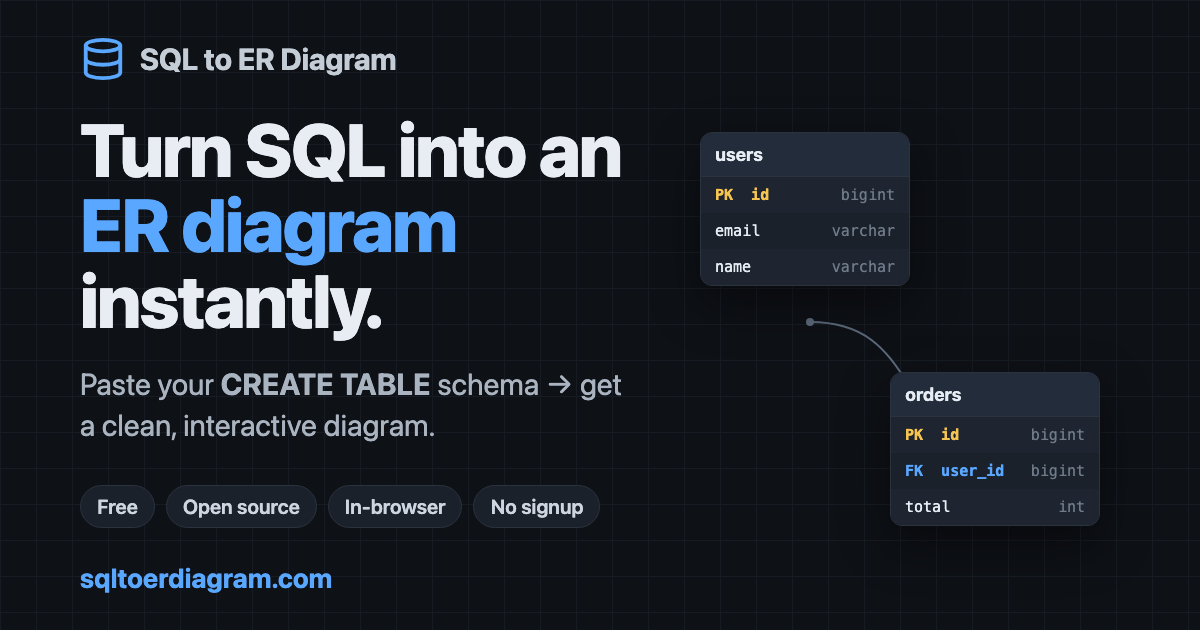
sqltoerdiagram.com is a free, browser-based tool that converts SQL DDL into entity-relationship diagrams with no signup and no server-side uploads — the schema is encoded directly in the shareable URL. It supports PostgreSQL, MySQL, SQLite, and SQL Server, and exports to PNG or SVG. Simple, fast, and privacy-respecting: this is the kind of developer utility that earns its 285 HN upvotes by doing exactly one thing well.
Relevance 3/10Importance 5/10
Gary Bernhardt's legendary PyCon 2014 conference talk has resurfaced on the HN front page. It's billed as "science fiction / comedy / completely serious," tracing JavaScript's trajectory from 1995 to an imagined 2035, and despite cataloguing the language's well-known flaws with comedian's precision, Bernhardt concludes its net impact on computing was "tremendously positive." If you haven't seen it, it holds up remarkably well twelve years later.
Relevance 2/10Importance 3/10
This piece traces Ruby's design DNA directly back to Lisp: Matz has described starting from a simple Lisp, stripping macros and s-expressions, then layering on an object system and Smalltalk-style methods. The post walks through how the ? and ! method naming conventions, closures and blocks, symbols, and the Enumerable collection methods all descend from Lisp traditions — the lambda calculus of 1958 is hiding inside every Ruby block you've ever written.
Relevance 1/10Importance 2/10
A browser-based 3D firewood-splitting simulator: you click to split a log, drag to rotate it. That's the entire product. It earned 175 HN upvotes from developers who demonstrably had other things to do, and it is extremely good. No AI, no startup angle, just a beautifully crafted web toy.
Relevance 1/10Importance 2/10
FarOutCompany is a visual archive described as "countercultural visual overload," dedicated to art and publications from the 1960s and 1970s counterculture. It's richly designed, deeply niche, and utterly irrelevant to AI or startups — which is fine. Someone is doing the work of preserving this material on the web, and that's worth noting.

 HN Briefing AM