Relevance 10/10Importance 9/10
Noam Shazeer, co-author of the seminal 2017 "Attention Is All You Need" paper and most recently co-lead of Google's Gemini program, is leaving Google for OpenAI as its Lead for AI Architecture Research. It ends a roughly two-year second stint at Google, which paid about $2.7 billion in a 2024 Character.AI licensing deal to bring him back. Sam Altman called him "one of the people I have most wanted to work with since the very beginning of OpenAI."
Relevance 9/10Importance 9/10
A new development on the Fable/Mythos export-control story: reports now point to SK Telecom as the South Korean carrier whose suspected China ties triggered the White House to suspend foreign-national access to Anthropic's Fable 5 and Mythos 5 models. SK Telecom, which had secured early Claude Mythos access via Project Glasswing on June 4, flatly denies any linkage with China and questions the anonymous-sourced reports. The administration reportedly lost confidence in Anthropic's safeguards after spotting the firm on a priority-access list.
Relevance 9/10Importance 7/10
DeepSeek has rolled out a dedicated Vision mode in DeepSeek Chat for image-understanding tasks, letting users upload images directly for analysis alongside its existing Fast and Expert modes. It marks the lab's first broad multimodal move, built on an efficiency-focused visual framework designed to cut compute. The capability is positioned as groundwork ahead of its V4.1 model update.
Relevance 8/10Importance 6/10
RTK is a tool that compresses terminal output for AI agents, claiming 60–90% token reduction and big API savings. The author argues the headline numbers are misleading because they reflect stripped command output rather than actual API bills, and warns the tool can silently corrupt critical information without the agent knowing. Without transparent accuracy benchmarks proving agents still complete their tasks, he says the reliability trade-off isn't worth it.
Relevance 8/10Importance 6/10
ARD is a proposed framework that lets AI clients discover external capabilities — tools, APIs, and other agents — by asking what resources can help with a given task. It targets the growing pain of manually wiring up and maintaining agentic capabilities scattered across vendors and organizations. By standardizing discovery, it aims to let a client find useful resources well beyond the small set it already knows about.
Relevance 7/10Importance 5/10
This Ask HN revisits Google's agent-to-agent (A2A) protocol now that MCP has taken over the spotlight, asking whether anyone is actually building on it in practice. The poster wonders whether agents equipped with their own tools, services, and data could benefit from talking directly to other agents for contextual relevance. It's a useful pulse-check on which of the competing agent-interop standards is gaining real traction.
Relevance 5/10Importance 6/10
Craig Newmark has now written about $450 million in charitable checks plus another roughly $37 million in commitments, and says he's no longer a billionaire largely because of his giving. He signed the Giving Pledge in 2025 and has narrowed his focus to combating disinformation, election security, and cybersecurity — plus, characteristically, pigeons. He credits Sunday school lessons about "knowing when enough is enough" for driving the plan.
Relevance 5/10Importance 5/10
Modos Flow is a 13.3-inch integrated color e-paper monitor at 3,200×2,400 resolution with touch and a 60-Hz refresh rate, a big step up from the startup's earlier dev kit. It's powered by a new open-source display controller called Enchanter that uses a DisplayPort 1.1 converter to drive higher resolutions while keeping the company's open-documentation ethos. With ~50ms pixel response, it pushes e-paper closer to LCD usability for everyday work while keeping the low-power, eye-friendly upside.
Relevance 4/10Importance 4/10
A practical write-up on moving a dotfiles setup from the symlink-based GNU Stow to Chezmoi, which manages config files with templating, secrets handling, and per-machine differences. The author walks through why Stow's pure-symlink model breaks down across multiple machines and how Chezmoi's approach scales better. It's the kind of quietly useful tooling post that earns a steady HN front-page slot.
Relevance 4/10Importance 4/10
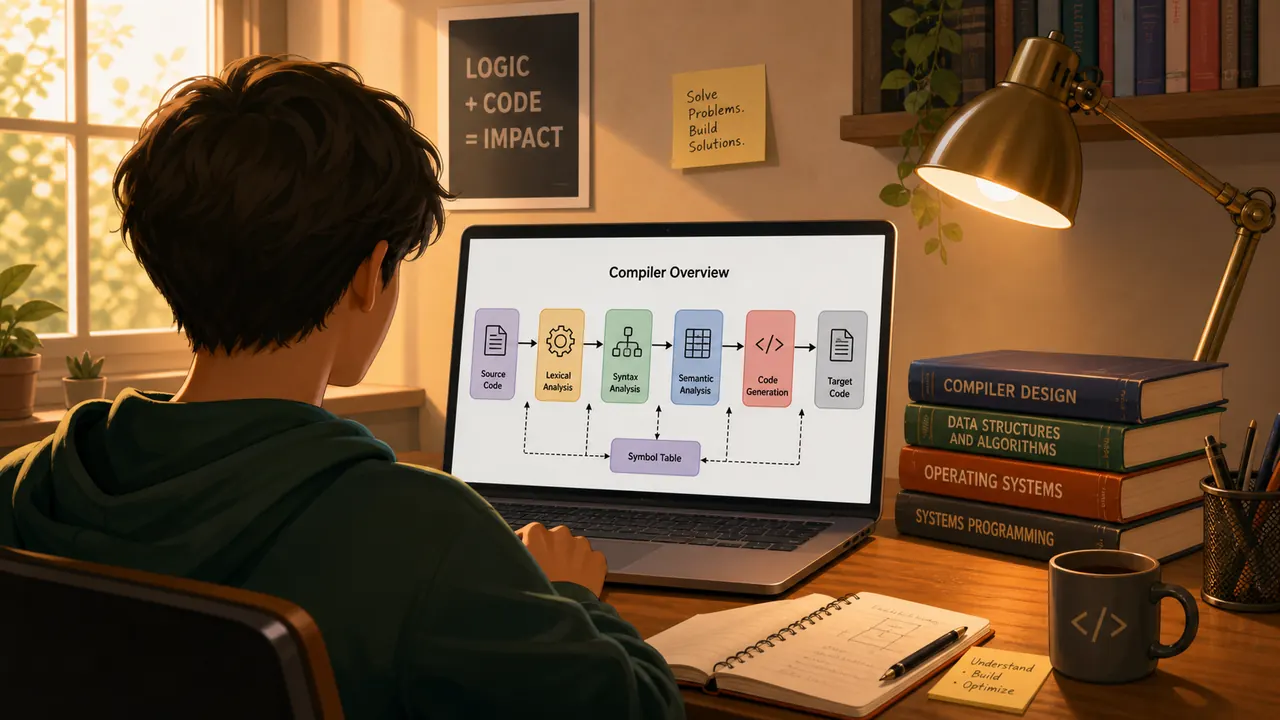
Cornell's CS 6120 is a free, self-guided graduate compilers course covering IRs, dataflow analysis, optimization, and more, with lectures, readings, and open implementation tasks. It's resurfacing on HN as a high-quality resource for engineers who want to go deep on how compilers actually work. A perennial favorite for the build-it-to-understand-it crowd.

 HN Briefing PM